People Never Suck in Just One Way: On Epstein, Climate, and the Hubris of the Ultra-Wealthy

As an investigative reporter with a thing for documents, normally a massive release of previously hidden emails and texts would be exciting for me, but the Epstein files are as deliberately disorganized as they are depraved, so I can't say that I've approached them with excitement or curiosity so much as roughly the same emotion I have when hunting through the garbage for something I accidentally tossed in there. That said, they do provide a window into how some of the worst and most powerful people in the world view things, and that's pretty helpful at this moment in time.
More than anything, for me they confirm my most deeply held belief: that people never suck in just one way. Allow me to offer a low-stakes personal story by way of example. My neighbors are from Alberta, Canada. They made a bunch of money in the tar sands oil business and used it to ditch Canada for Costa Rica, where they've lived for 17 years or so. They refuse to speak Spanish, but I have heard them on more than one occasion complain about people in Quebec insisting on speaking French instead of English. Everything they love about Costa Rica—the beauty, the laid-back attitude, the prices—is the result of policies they would never support back home. Their house has a giant Bless Texas sign at its entryway, though they've never been to Texas. When we went over there for pizza once, as sort of a "welcome to the neighborhood" thing, as they were taking orders they said, "I hope you're not vegetarian or anything, because FUCK THAT."
My take was "probably not gonna hang out with those folks," and my husband's was "I don't let people's politics color what I think of them, you should give them a chance." Here's the thing: I wasn't going to avoid them or be rude or unkind to them, and I fully planned to blow their minds with how much they actually agreed with a "radical liberal" (and I did), I just also knew that if they had these particular beliefs and behaviors, they would probably be shitty neighbors too. And of course, that turned out to be the case. They're the ones lighting giant fires or making a lot of noise or being casually racist to the locals or refusing to pay into the pot when the neighborhood gets together to do something.
You know who doesn't suck? Drilled readers! Your support keeps us going. We're working on a ton of projects coming up, with big stories on migration, disinformation, the increasing attack on civil society groups and much more. If you're not already a paid subscriber, please consider becoming one today. Thank you!
In the political realm, we've reported a lot at Drilled on how the same people and organizations who are against acting on climate are against the rights of anyone different from them, against repairing colonial harm, against fairness and equity in the world across the board. No surprise, then, that many of them are also misogynists and sexual predators in their personal lives.
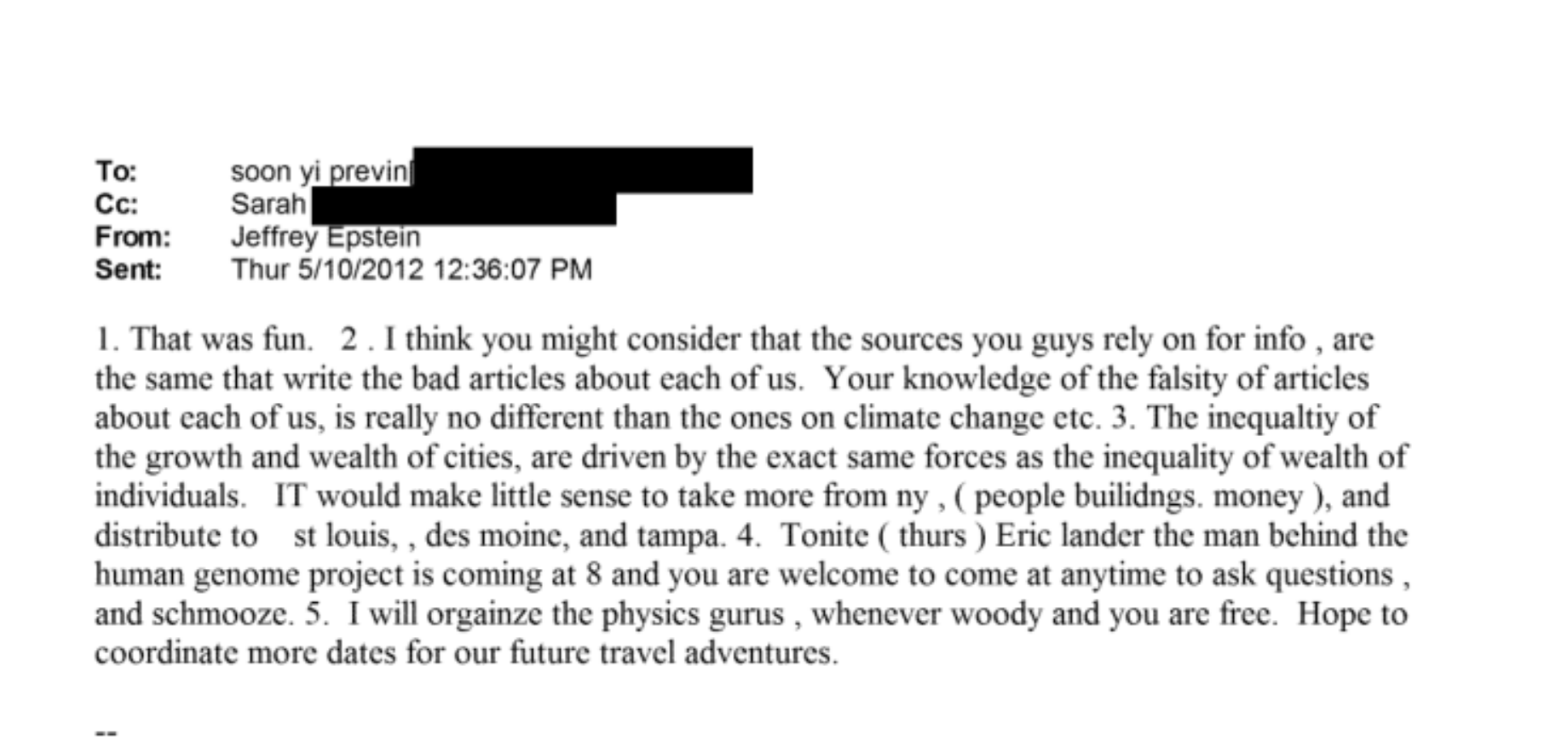
There's an email in the Epstein files that illustrates this clearly. Epstein is writing to Soon-Yi Previn, Woody Allen's wife and the adopted daughter of his ex-girlfriend Mia Farrow, and he cautions her about her media diet. "I think you might consider that the sources you guys rely on for info are the same that write the bad articles about each of us. Your knowledge of the falsity of articles about each of us is really no different than the ones on climate change, etc." The logic is wild: That newspaper runs stories that do not align with my opinion of myself, therefore they are inaccurate, and that must mean they are inaccurate about everything. But it's the sort of thinking that comes up in a lot of Epstein's correspondences.
In emails with various Microsoft executives (turns out, it's not just Gates) and occasionally academics, some of whom do take him to task for being unscientific in his approach, Epstein trades in climate skepticism theories ranging from the idea that more CO2 is actually good for the planet because it will grow more plants ("i liked the argument," Epstein writes) to the idea that climate change is natural and has always happened, therefore human activities have no impact on it (astrophysicist, geoengineering proponent, and Gates Foundation consultant Lowell Wood sending around a Steve Koonin column that he, Epstein, and former Microsoft CTO Nathan Myhrvold approve of). He also veers into eugenics and ecofascism, writing in correspondences with German philosopher and AI researcher Joscha Bach that climate change-fueled extreme weather events might be "a good way of dealing with overpopulation," as Fast Company reported.
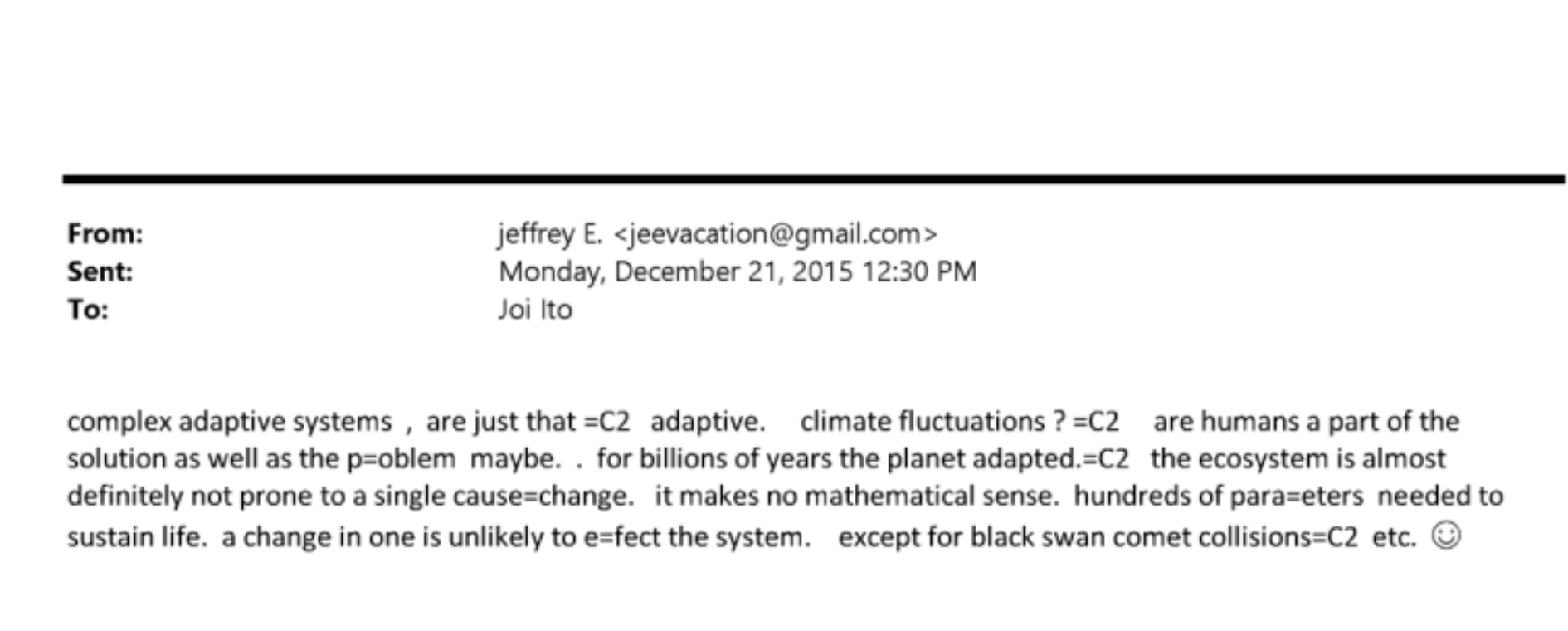
In what is apparently a classic Epstein run-on non sequitur email—because in even the smallest of ways, this man spent his life screaming, "the rules don't apply to me!"—he "schools" former MIT Media Lab director Joi Ito on climate, explaining that it can't be a real problem because "the ecosystem is almost definitely not prone to a single cause=change. it makes no mathematical sense. hundreds of parameters needed to sustain life. a change in one is unlikely to effect the system. except for black swan collisions=C2, etc 🙂"
What also jumped out to me in reading through some of these was the extent to which Bill Gates has surrounded himself with climate skeptics—at his company, at his foundation, and in his life. They all seem to be whispering in his ear that out-of-control consumption is not the problem, nor is it billionaires or private jets, or data centers, or AI, or the tech companies working overtime to help the oil companies drill ever more oil and gas, no no. In fact none of the myriad things Gates could do something about are worth even considering; instead, we should be installing mirrors in the sky.
A single thread runs throughout: the rules don't apply to me. Of course they would think that applies to the rules of the universe, too.
Become a paid subscriber to Drilled for early access to stories and seasons, ad-free podcast episodes, and...just to support our reporting. Thank you!
This week's climate must-reads
- Trump administration urges nations to call for the withdrawal of a UN climate proposal, by Farnoush Amiri, Edith M. Lederer, and Matthew Lee for the Associated Press—The next step in the process towards giving last year's International Court of Justice climate ruling teeth is a United Nations resolution proposed by Vanuatu (whose student climate activists also spearheaded the ICJ case). Now the Trump administration, which has withdrawn from the Paris Climate Agreement and announced its intention to withdraw from the UN Framework on Climate Change, or UNFCCC, the treaty that forms the basis for international climate negotiations, is pressuring UN member countries to pressure Vanuatu to withdraw its proposal.
- Relatedly, The New York Times reports that U.S. energy secretary and fracking CEO Chris Wright issued a demand to the International Energy Agency that it needs to stop publishing its annual roadmap for cutting emissions, or the U.S. will leave...after which it will presumably continue to issue ultimatums from the sidelines.
- “Simply Cannot Be Ignored”: How Australia’s fossil fuel industry shaped the climate future by capturing economic models by Royce Kurmelovs for Drilled - We have a little bit of an obsession here at Drilled with the way economic models have been warped and how they in turn warp climate discourse. This week, Royce Kurmelovs walks us through how industry-captured models came to dominate an influential Australian government agency.
- Under water, in denial: is Europe drowning out the climate crisis? by Ajit Niranjan for The Guardian - Europe might be staying in all the climate agreements, but Niranjan notes that far-right parties are gaining ground and US climate denial think tank the Heartland Institute is putting down roots on the other side of the Atlantic, spelling trouble.
- Paris Court Holds Historic Climate Trial in Case Against TotalEnergies, by Dana Drugmand for Inside Climate News - In a case similar to the one brought against Shell in the Netherlands, French NGOs are suing TotalEnergies for oil and gas expansion plans that would send the country rocketing past its emissions agreements under the Paris Climate Agreement. It's a huge case that could set a global precedent if successful.
- As Europe Leaves Controversial Treaty, the Secretariat Courts Resource-Rich African Countries by Rishika Pardikar for Drilled - The Energy Charter Treaty is often pointed to as an example of why the Investor-State Dispute Settlement (ISDS) system is a big problem for climate action. A key aspect of the treaty, and many others like it, is the commitment to settle any disputes via a secretive tribunal system that tends to punish governments for passing legislation seen as unfriendly to business, particularly related to environmental and human rights issues. Now, as the European Union and several member countries leave the treaty en masse, it's actively recruiting African countries as signatories.