Petromasculinity Is Eating Itself and Destroying Us All
By Amy Westervelt
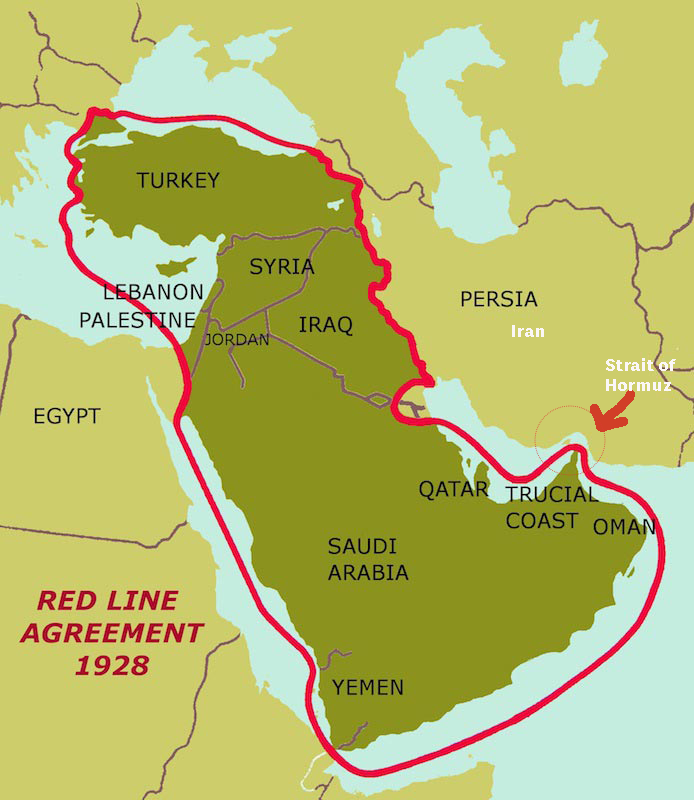
Like a lot of other folks who came of age in the 90s, I'm having Iraq War flashbacks at the moment. The U.S. and Israel's illegal war in Iran is also bringing to mind a nearly 100-year-old deal that made the U.S invasion of Iraq make the smallest bit of sense to me when I first learned about it a few years ago via a Standard Oil of New Jersey (the company known today as ExxonMobil) primer. The "Red Line Agreement" was a negotiation between U.S., U.K. and European oil companies in 1928 to divvy the Arabian peninsula up amongst themselves. It gets its name from the literal red line these companies drew around the peninsula. Standard had been promised access to Iraq's oilfield, which helped me understand why American oil companies decades later had seemed to feel so incredibly entitled to Iraqi oil. It didn't justify it, of course, but I could at least see what had inspired that level of entitlement.
I'm also thinking a lot about the parallels from the U.S.-Israeli invasion of Iran and Russia's invasion of Ukraine—the pretense that it's not war, the attempt to frame aggression as anything but (in this case...preemptive defense?), the promise that it will be quick, the devastation caused by a small group of power-hungry men, and of course the sudden and devastating impact on the world's energy system. Which in turn has me thinking of another historical period: the 1970s, when the Arab oil embargo cut Americans off from the cheap fossil fuels they'd relied upon to build overly consumptive lifestyles.
A decade or so ago I was trawling through the archive of Standard Oil of California's (now Chevron's) shareholder magazines and was struck by how many of them during the 1970s had been dominated by anxiety and fear—not over OPEC or access to Arab oil, but over how good Americans had gotten at conservation and efficiency. How quickly people had realized they didn't actually need to drive so much or have such big cars or leave the lights on or crank the air-conditioning. They had realized that moderating a little bit even made their lives better sometimes—walking or biking instead of driving, being in community with their neighbors on the bus or train, saving money on electric bills. In the early 1980s, as production increased and the embargo lifted, oil executives were in an outright panic. Americans didn't seem to be in a rush to let their new lifestyles go, what was an oil company to do? The answer was increase production, tank the price of oil to a point where people would start over-consuming again, and take the short-term financial hit in exchange for long-term gain.
Lest you be tempted to blame it all on Republicans or Trump, it's hard to think about the 1970s oil embargo without thinking of the Obama administration's decision in 2015 to lift the U.S. oil export ban, which had been in place since 1970s. Similarly, would we be in the position we currently are—with so much of the world so dependent on LNG—had so many Democrats not embraced the idea of methane, a fossil fuel, as somehow a "bridge fuel" from oil and coal to renewables?
If the federal government hadn't lifted a 40-year oil export ban during the late Obama years, how would that have changed today's calculus of profit from the Iran war for US oil company owners, major shareholders, and executives?
— Kevin J. Kircher (@kevinjkircher.com) 2026-03-15T15:42:45.974Z
Hi there! Something we really focus on at Drilled is the connecting dots—between the past and the present, between the Global North and Global South, between the fossil fuel industry and the tech industry, and so on. Building that breadth takes time and focus. Your support helps to ensure both!
In the wake of Russia's invasion of Ukraine, Europe saw a couple years of real efficiency gains and reduced gas consumption until it was bullied back into its abusive relationship with fossil fuels largely by U.S. companies and the politicians who work for them.
"We reduced gas consumption in Europe by 20 percent the first two years after Russia's invasion of Ukraine," says Ana Maria Jaller-Makarewicz, lead energy analyst on Europe for the Institute for Energy Economics and Financial Analysis, IEEFA, a nonprofit energy policy think tank. "So that helped us diminish risk in our energy supply, but we relaxed and in 2024, for the first time since the [Feb 2022] invasion of Ukraine, gas demand didn't decrease, and then in 2025 it actually increased a little bit, like 2.6 percent. So, we forgot the issues that we had, and what we are seeing now is that we have increased dependency on US LNG, and we still import Russian gas, via pipelines."
Jaller-Makarewicz says that has set the EU up for possibly an "even worse situation than what we saw in 2022," partly because exports to Asia have increased exponentially, driven by the desire of US and Australian producers to flood that market in order to get Southeast Asia hooked on cheap gas. "So now we are going to be fighting for the same LNG with Asia."
And Russia is of course also taking advantage of the war in Iran to threaten that they will immediately stop the transit of gas to Europe unless the EU stops defending Ukraine. On top of all that—and bringing us right back to the Red Line Agreement of 1928—as it retaliates against the US, Iran knows the best target is not necessarily on US soil, but Middle East oil and gas infrastructure. The combination of hitting a gas facility in Qatar and shutting down the Strait of Hormuz is a double-whammy to U.S. oil majors and the government they spent millions of dollars to put in place.
In its latest power play, Iran has offered to open the Strait of Hormuz—a critical passageway for 20 percent of the world's oil and gas—for those conducting their energy trade in yuan instead of the dollar. This threatens the longstanding "petrodollar" grip the U.S. has had on the rest of the world, a system in which it has been able to insist for decades that the world buys and sells oil and gas in dollars. Dismantling that system could be a nail in the coffin for the U.S. dollar.
All of this puts Europe in a particularly tight spot as well. "We'll be losing the gas from Russia plus the LNG from Qatar...that's double the volume of what we lost of Russian gas in 2022," Jaller-Makarewicz says. "So we are in a more critical position now. The more this crisis escalates and the longer it takes to be resolved, the more we will be affected. Let's say Iran opens the Strait of Hormuz? We still don't know when Qatar is going to start production again, when it's going to be able to export."
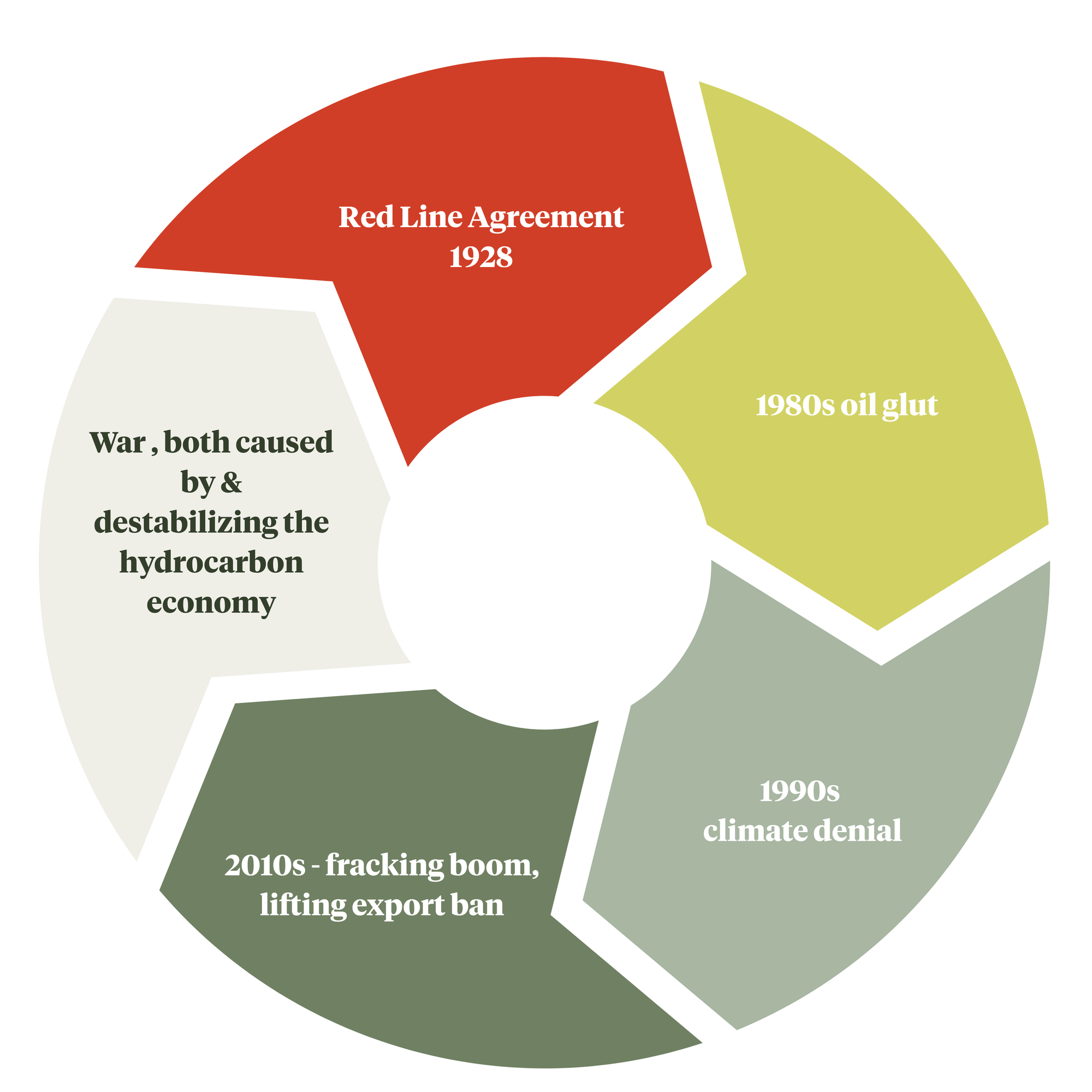
For decades, the fossil fuel industry has worked hard to link national security and energy security with dependence on fossil fuels, despite the fact that even the U.S. military has for several years warned about the security risks that dependence entails. Now the whole world has a front row seat to the implosion of not just the petro-world order, but the petro-masculine world order, as aggressive dictators jockey for whose barrel of oil or pipeline of gas is bigger and more importantly, who has the most control over this risky global energy system.
When political scientist Cara Daggett coined the term "petro-masculinity," it was not solely in relation to fossil fuels, but also to authoritarianism. The complete title of the 2018 paper that gave birth to the term was "Petro-masculinity: Fossil Fuels and Authoritarian Desire." When she spoke with us in 2025, Daggett said that during the first Trump administration, it struck her as odd that people were still talking about misogyny, racism, far-right populism and climate denial "as if they are coincidentally inhabiting the same movement," when for decades feminist and ecofeminist work had been pointing to "the structural connections between the way so-called "women's work" or reproductive labor is exploited and treated and the way that often racialized work and colonial work is exploited and treated and then also the way that the work of nature or the work of non-human animals and creatures and plants is exploited and treated."
"These kinds of justifications and narratives are really interconnected," Daggett said. "And on the one hand, it's this deep structural thing that can be very hard to see, but on the other hand, conveniently now, although tragically, it's very easy to see on the surface that these things are coming together."
It's so obvious that it's not even just people who focus on climate pointing it out anymore. Timothy Snyder, the American historian whose small treatise On Fascism became required reading during Trump's first term, pointed out that we wouldn't be dealing with authoritarians globally if we weren't letting oil majors call the shots:
If we made the green energy transition this war would be unthinkable and these authoritarians wouldn’t be in power — not in the US, not in Iran, not in Saudi Arabia, not in Russia. Hydrocarbons are killing our freedom and just plain killing us.
— Timothy Snyder (@timothysnyder.bsky.social) 2026-03-15T00:07:27.353Z
What's also easy to see in the current moment is that petromasculinity is a threat to everything, even itself. In their eagerness to "cancel" renewables and equality and human rights and blast everyone in the face with hydrocarbons instead, the petrobros have flown too close to the sun. Though the industry and the politicians who carry water for it are still trying to push their fossil-fueled "energy dominance" and "energy security" messages, they are increasingly falling on deaf ears. The chorus falls flat in the face of two energy- and economy-destabilizing wars in four years. It's become too obvious that fossil fuels are anything but a secure bet, particularly when France and Spain are so clearly not facing the same catastrophe as the rest of the European Union, based solely on their respective moves to stop riding the hydrocarbon dragon. In its latest analysis, global energy think tank Ember found that "in Spain, gas influenced the price of electricity in only 15% of hours in 2026 so far, compared to 89% in Italy."
1/ Disruptions mean countries will rush to exit US-led oil order Worst case scenario for oil companies (best for rest of us) is that people permanently shift...what they call “demand destruction“ i.e short term pain but Long: Iran war will accelerate ongoing STRUCTURAL shift to solar+EVs+batteries
— Albert Pinto (@70sbachchan.bsky.social) 2026-03-15T18:10:56.602Z
No one wanted endless, senseless war to be the thing that tipped the global scales in the direction of energy transition. As is the case with the climate crisis itself, those who have done the least to cause the problem are suffering the gravest consequences.
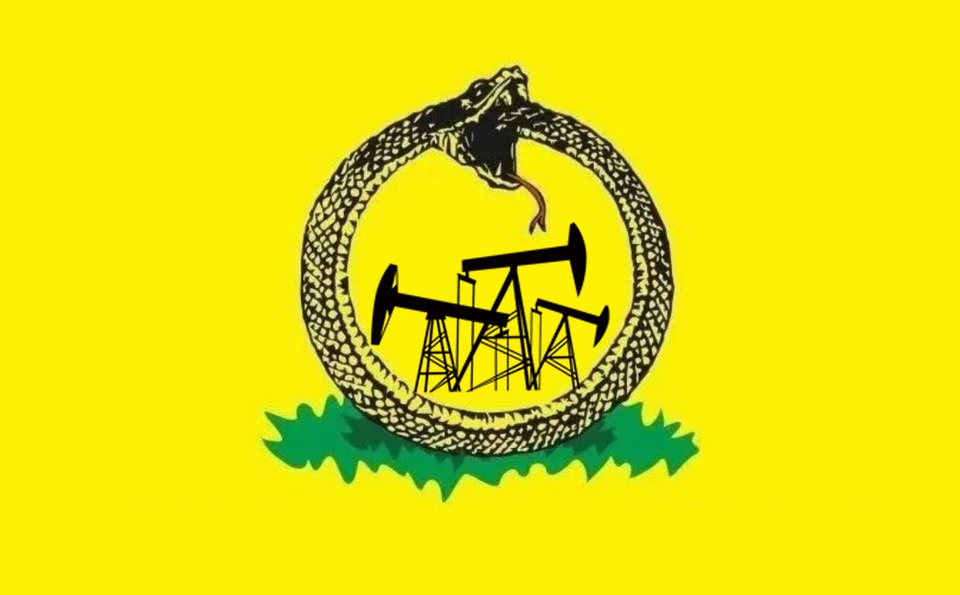
We at Drilled—and lots of other folks too!—have said for years, that there were only two ways this could go: managed transition or chaos. We could have had a managed, phased transition, the choice was there for the taking decades ago. Instead, the hydrocarbon cartel set us on this path and insisted upon it; now it will be the death of them, too. The snake is eating its tail, and it has no one to blame but itself.
This Week's Climate Must-Reads
- Trump Administration to Pay $1 Billion to Energy Giant to Cancel Wind Farms, by Maxine Joselow and Brad Plumer for The New York Times. Not unexpected from Trump, but wild that Total Energies is going along with this.
- Conscious Uncoupling: Can America's allies bypass the hegemon? by Kate Mackenzie and Tim Sahay for The Polycrisis newsletter at Phenomenal World. Kate and Tim write my personal favorite newsletter and there's absolutely no one better to tune into at this moment in time.
- Big AI Is Gambling with the Planet’s Chips, by Adam Lowenstein for Drilled. Reporter Karen Hao's book Empire of AI shows how the AI industry is cribbing from Big Oil to build a colonial project. (If you prefer to listen, it's our latest podcast episode too!)
- Earth, Bound, by Scott W. Stern for The Baffler. A fascinating look at how the working class was left out of the origins of international environmental law and how that mistake has reverberated in the decades since.
- China has been preparing for a global energy crisis for years. It is paying off now. By Callum Jones in Sydney for The Guardian. In addition to its booming renewable energy industry, China is sitting on huge reserves of oil and gas.