
The Unbearable Bleakness of "Inevitability"
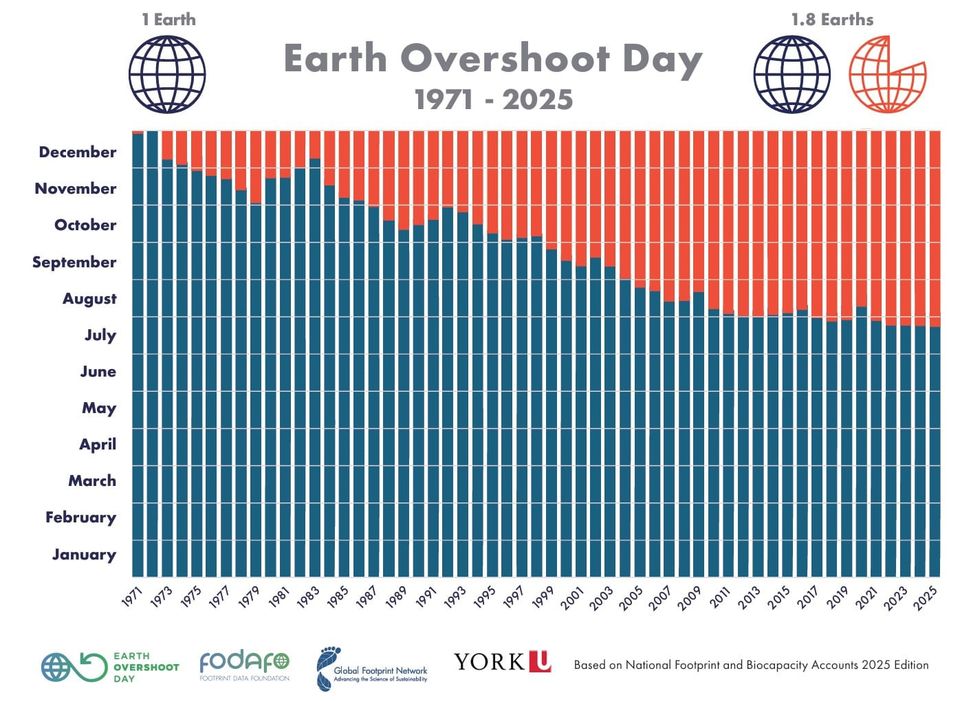
My entire adult life people who are supposedly sensible have been telling me some catastrophe or another is “inevitable.” Nuclear war, climate change, and now the AI takeover. Apparently the “end of reading” is also inevitable. My kids’ school principal told me last week that it was “inevitable” that humans would stop writing, too. People need to find a dictionary and stop asking ChatGPT what “inevitable” means!
While rightwing pundits have built a veritable cottage industry out of telling people to stop being “alarmists” about these issues, I find the so-called “moderate” position—that these crises, which are all eminently avoidable if we simply make different choices, are instead inevitable—far more galling.
Earlier this month the United Nations Environment Programme announced that overshoot, the term coined to describe the notion that we can warm past 1.5 degrees then use technology to pull the climate back into a safe temperature, is locked in. The same report described carbon dioxide removal technologies in much the same way, despite the fact that that technology has never worked at the scale it would need in order to effectively draw down the emissions UNEP hopes it will. We have been hearing for a decade that both overshoot and the reliance on carbon capture to deal with it are "inevitable," often by those with a vested interest in making this true. In a similar vein, tech entrepreneurs and pundits keep telling us that AI is inevitable, and it would be naive, radical, pick a pejorative to “bury our heads in the sand” and ignore it as opposed to jumping in feet first.
Hey guess what? I wrote a book! Please if you have ever enjoyed any of the mountain of free content we have produced at Drilled, consider buying it. Pre-orders apparently help immensely with things like best-seller lists, although I admit I don't understand such things. The book focuses on how various industries have shaped an information ecosystem in which it's deadly easy to push a frame like "inevitability."

It’s one thing to tell someone to calm down when you genuinely think, or at least are being paid to pretend you genuinely think, that they are overreacting to a problem, that their alarm is creating more of a disaster than the one they’re worried about. It’s so much worse when you know full well that the crisis is real but you lack the imagination or courage or faith in humanity to believe that humans can do something about it.
This is the same groupthink that Martin Luther King, Jr. warned about when he wrote, “The white liberal must rid himself of the notion that there can be a tensionless transition from the old order of injustice to the new order of justice.” Except expanded to a whole class of people, those who are comfortable with the status quo, who might, say, buy an electric car or recycle but don’t want to give up on the idea of everyone having their own car altogether; or who hate the idea of AI but think ChatGPT just makes for a better search engine. The liberals who couldn’t wait to chuck the protests and “go back to brunch” once Trump left office. Many of them are amongst what passes as leadership in the climate movement these days too, lecturing that we must "be reasonable" and now is "not the time" to talk about climate change. Apparently it's also not the time to talk about fascism or genocide, no, no we must always think first about what is "politically attainable" and then at some later date that never comes, we can talk about the world we actually want to live in and how to build it.
While this position is described over and over again in the press, which is largely composed of people from the same class, as “moderate” or “reasonable,” it is anything but. When you know a preventable crisis is bearing down on you, and you know what to do to stop it, the sensible thing to do is act, not to fiddle around with your shopping list and ignore it. The reasonable recommendation right now is to do absolutely everything possible to stop the AI buildout and rapidly transition away from fossil fuels, and lucky for us those two things are inextricably linked. The data center buildout is ratcheting up the use of fossil fuels exponentially. Why not cancel both? Is it really more radical to make that suggestion than to suggest that 90 percent of the planet suffers enormously so that 10 percent of humans can remain comfortable?
I for one am sick of the Overton window only ever opening to the right. When's the last time you heard anyone from a Project 2025 organization talk about what was "attainable" as a way to censor discourse or right-wing fever dreams? Why are progressives in general and the climate movement in particular so ready to self-censor? I realize that the Trump administration is going after climate organizations and anyone that points out the extent to which it is doing the bidding of Big Tech and Big Oil, but preemptive compliance has never worked and this time is not going to be different.
What’s particularly maddening about this embrace of inevitability is that it requires one to believe that they themselves will be spared the impact of this or that inevitable crisis, which means it also requires not having a single iota of care for people who are not in one’s close circle.
Climate change offers us a window into how radical this supposedly moderate idea really is. The best piece of evidence we have for how society responds to a large shift in temperature is the “Little Ice Age,” which affected only Europe and the North Atlantic and brought with it a temperature change of just half a degree: It ended feudalism and helped spark modern capitalism. A comprehensive overhaul of the global economic system, from just half a degree in just one region of the world, but sure your status quo will keep on status quo-ing.
While we still have democracy in a great part of the world, now would be an excellent time to exercise your rights within it. We can say no to these things, we can force the issue, we can make revolution and justice just as inevitable as a robot apocalypse, and we owe it to ourselves and future generations to try.