Nepal Floods Put Climate Loss and Damage Fund to the Test
An interview with Raju Pandit Chhetri, a climate negotiator from Nepal, about the country’s demands for loss and damage financing and climate justice.
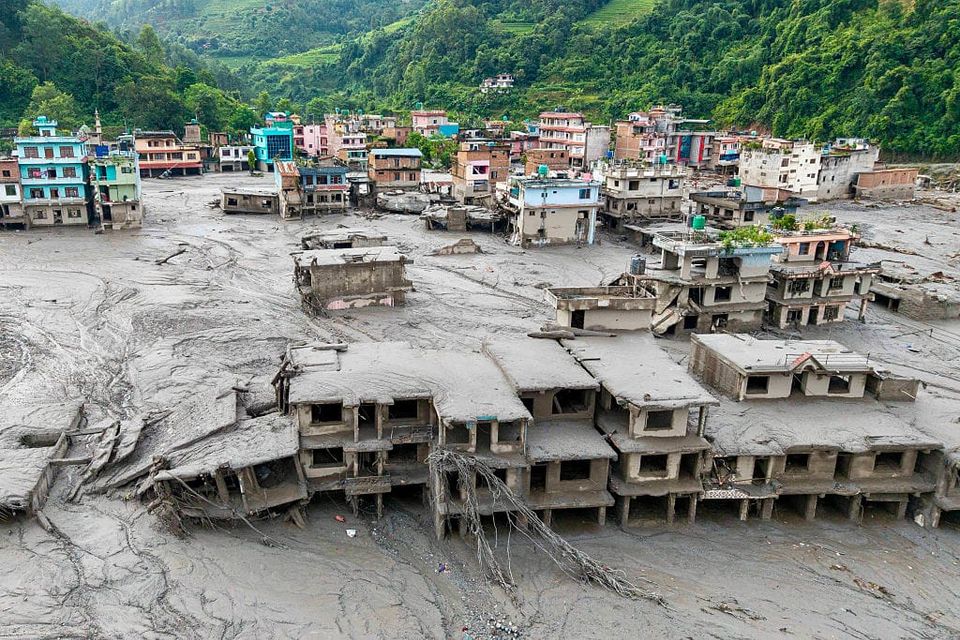
On the morning of 26 August, a series of flash floods and debris flows struck parts of Tibet and Nepal. Scientists have identified the trigger as an ice-rock avalanche and bedrock landslide in the Himalayan mountain range, driven in large part by background warming due to climate change, which has led to permafrost melting and glacial retreat. Photos and videos of the floods sent shockwaves around the world, a stark reminder that climate change is not a far-off threat, but one that is very real and very present. As of today, the death toll stands around 1,300 with over 5,000 people still missing.
In some hopeful news, two men were rescued this morning from a hydropower tunnel, raising families' hopes that their loved ones might still be alive. Roughly 900 people working in Nepal’s hydropower projects are currently missing. Over the decades, Nepal, India and China have built large hydropower projects, tunnels and highways in the Himalayas. Such projects often come under criticism for environmental harms. Now, the flooding disaster has brought fresh focus on the need for thorough environmental impact assessments prior to construction.
On 2nd September, board members of the Loss and Damage Fund from Africa, the Asia-Pacific and the Least Developed Countries (LDCs), of which Nepal is one, sent a formal letter to the Co-Chairs, the Board, and the Executive Director of the Fund, requesting that they convene an emergency meeting of the Board to consider an urgent and appropriate response to the catastrophic floods in Nepal.
Drilled interviewed Raju Pandit Chhetri, a climate policy expert and negotiator from Nepal to understand the country’s struggle with the disaster, some controversies and demands for international assistance and climate justice. The interview has been edited slightly for length and clarity.
What is the situation like in Nepal today and how is the government handling it?
It has been over a week since the disaster occurred. At the moment, the focus is still on rescue and relief. One thing the government is working very hard on right now is to rescue people from the main tunnel in the Trishuli hydropower project. Around 100 workers are trapped in this tunnel. Very fortunately, just this morning, the government was able to access the tunnel and two people were rescued. It is a good sign that people are still alive after more than a week. But of course, beyond this, the focus is to provide relief to meet basic needs like food, shelter and clothing. On the other hand, the government is also trying to communicate with the international community so that we can have more support coming in. Right now, India, China, South Korea and Australia are providing technical assistance for tunnel rescues because we do not have such technologies. But the situation on ground zero is still really bad. A lot of people have no information about their families, whether they are alive or not. The government also has only little information to give. The magnitude of the problem is huge.
What kind of international assistance is Nepal seeking?
The first kind of support the Nepali government accepted was humanitarian aid. We received overwhelming support from governments and other institutions and also individual donors. Countries like China, India and Singapore have sent tonnes of relief material. Nepali people are grateful to all the contributors. The second thing is we have a Prime Minister’s Disaster Relief Fund. Here too, we have received overwhelming support in terms of direct financial assistance from governments, institutions and individuals, including from Nepal. Very recently, Nvidia, an American company, contributed $10 million to this fund. The third thing the government is looking for are places from which to access immediate support—one of the windows for this was the Loss and Damage Fund. The objective of the fund when it was initially set-up was “rapid response”. The Nepali government has sent a letter inquiring about the fund which was specifically set up to deal with disasters like this. We have not requested any specific amount yet. We have not made any specific proposals as of now but we know the second stage will come soon where we need to move beyond rescue and relief. This second stage will have elements like reconstruction and rehabilitation. For this, our initial assessment shows we will need about $5 billion. Nepal alone cannot provide such a huge amount and we will need support.
The Loss and Damage Fund was set-up at COP27 in Sharm el-Sheikh, Egypt. What is the status of this fund? It seems like there is a hold-up.
The Fund was operationalized at COP28 in Dubai where various countries pledged around $850 million. But only about 50% of the money has been put into the fund. If we remove operational costs and secretariat costs, the fund has only about $350 million for its program, called Barbados Implementation Modalities, to support countries. So far, the applications by developing countries to access the fund have been overwhelming—it stands at about $2.8 billion. And until now, no money has actually been provided for program-related work. Nepal also has a pending application for a flooding disaster from a few years ago. We are looking forward to the upcoming board meeting of the fund in the Philippines where some projects will be sanctioned.The Fund is supposed to have rapid disbursement as its response. The board will have to call a special meeting so that it can decide how to respond to the call from Nepal. This is the first time that the Fund faces calls for a rapid response. This will be a real test for the Fund. Is this international fund ready to respond when it comes to such a huge scale of loss and damage? This is the big question at the moment. If you set up a fund under the UNFCCC and Paris Agreement but it is not responding in a situation like this, then what do we do? What is the use of the fund if it cannot respond to needs? Such disasters can happen again in Nepal. They have happened, at a smaller scale in Uttarakhand in India. And in 2022, there was a big flood in Pakistan. If a fund is established with the responsibility of developed countries to deal with extreme events, then we need to make the fund work.The governing instrument of the fund talks about rapid response but it has not been tested yet. Even if the board does not provide money urgently to Nepal, they will have to prepare for future course of action and develop modalities to deal with immediate relief. This is why board members from Africa, Asia-Pacific and LDCs have called for a meeting of the fund.
If the fund has only about $350 million to actually address loss and damage, then that is not enough for Nepal alone given the scale of the current disaster. Is Nepal seeking more contributions to the fund. If yes, from whom?
Definitely. The demands from developing countries for loss and damage [as per applications received at the moment] is $2.8 billion. The fund was created with a responsibility for developed countries. Of course, if others want to contribute they can do so voluntarily and as part of South-South cooperation. At COP28, the UAE put in $100 million. But the primary responsibility is of the developed countries to make the fund work when there is a need to address loss and damage. Failing to make the fund work means failing the people who are suffering in countries like ours. Is this the message we want to send? Developed countries need to take the lead and say we are accountable and we are responsible. We are not asking developed countries to solve all our problems. We are only asking for fulfillment of promises which are a part of written agreements.
A recent interview of the foreign minister, originally conducted in the Nepali language, created some controversies. Many media outlets, including Indian ones and international ones like Bloomberg and the BBC, translated and interpreted the comments by the minister as Nepal seeking compensation for the floods from China, India and the United States. Could you please clarify? What is Nepal’s official position on this?
There was confusion and some tweaking in the interview by the foreign minister. To be very clear, Nepal has not changed its position on the responsibility of developed countries in causing climate change and to provide support based on the principles and provisions of the UNFCCC and the Paris Agreement. This is absolutely clear. I know Western media has really picked on this… Nepal has always gotten support from China and India at times of crisis like earthquakes and flooding. We seek support from neighbouring countries and they have always provided support. We have regional cooperation and we need higher levels of cooperation in terms of sharing hydromet information because what happens in Nepal can have a huge impact on India. We see now that what happens in Tibet has an impact on Nepal. And what happens in India can cascade into Bangladesh. We need to be mindful about regional cooperation. But this is not an obligation like asking for compensation, as it has been interpreted in Western media and blown out of proportion. Under Article 9 of the Paris Agreement developed countries have a responsibility to provide resources. The other issue here is that the word ‘compensation’ is often loosely used. But it is not mentioned in either the UNFCCC or the Paris Agreement. We call it the ‘Fund for responding to Loss and Damage’ (FRLD) because that is what we agreed on during negotiations.
COP31 is coming up in two months. What are Nepal’s main demands from the negotiations?
Many people are calling this the ‘implementation COP’. The COP is happening at a time when we see many disasters, not just in Nepal but also in the heatwaves and forest fires in Europe. If we want to call it ‘implementation COP’, we need to rise to the occasion. We are currently at 1.4°C of warming and on a path to overshoot 1.5°C. This is a huge amount of warming for us and we are seeing record-breaking hot years. Imagine overshooting 1.5°C and going to 2°C and then beyond and the havoc it will create. If this is an implementation COP, we need to rise to the occasion and say our mitigation ambition will rise to align with the science. Developed countries need to take the leadership here. It is unfortunate that the US government has pulled out of the UN Convention and the Paris Agreement. And we also need implementation of the New Collective Quantified Goal on Climate Finance (NCQG) in provisions where public money will come in so that communities in countries like ours can access them when there is a need. Financial and technical support is extremely important. If we make promises and then do not deliver, it is a failure. The other important thing is that multilateralism needs to work. Right now, it is crumbling and priorities have gone to things like war. We need a focus on climate security and food security and health security. For this, we need multilateral cooperation.


Latest Climate Must-Reads (and Watches and Listens)
- [radio] "NPR spent 2 years tracking deaths from heat. We found a staggering hidden toll," by Alejandra Borunda for NPR - With Europe and the U.S. both hit by deadly heat waves, a key difference between the two has never been more stark: The EU measures and reports on excess heat deaths (some 35,000 in just the three summer months this year), while the U.S. does not. Partly that's a function of the United States' failing/non-existent healthcare system but it's also a matter of political will. This incredible project from NPR, teaming up with Boston University, aims to take the first big step towards changing that.The project reported some 9000 additional unreported heat deaths in the U.S. each year, far more than the 700 or so the Centers for Disease Control has been reporting. It's a big leap toward closing the gap, though still seems like a wild undercount given the numbers in the UK and Europe.
- [newsletter] "Oil executives just accidentally exposed the industry’s greatest weakness," by Saul Elbein for Heated - To keep drilling, Elbein points out, oil companies need permission to dump treated fracking wastewater into rivers and onto cropland. We don’t have to give it to them.
- [book] The Nerd Reich: Silicon Valley Fascism and the War on Democracy, by Gil Durán for Avid Reader - We are longtime fans of Durán's newsletter by the same name and his ongoing coverage and commentary about the technofascists of Silicon Valley, their "Network State" plans, and what all of it means for democracy. The book brings it all together in one very readable package!
- [read + listen] "What Standing Rock’s propaganda war means today," by Alleen Brown for High Country News and Drilled - Based on 100 pages of internal documents, this story—and the corresponding audio miniseries, "The Propagandist"—shows in terrifying detail how pipeline developers Energy Transfer worked to infiltrate and divide communities in an effort to protect the Dakota Access Pipeline.
- [book] Brought To You By: How Corporations Warped the Truth, Conned the Public, and Broke Democracy, by Amy Westervelt for Bloomsbury - Drilled's own Amy Westervelt has a book coming out this month and it's a must-read for any subscriber to this newsletter or the podcast, or anyone concerned about the current state of democracy for that matter. Each chapter reveals a different layer of the information ecosystem and how it has been warped by corporations eager to avoid taxes and regulations and generally circumvent democracy. It's got characters! It's got snark! And of course it's based on thousands of pages of primary documents and deep investigative reporting. Pre-order it now if you're able! Pre-orders help to get the book onto bestseller lists and to audiences beyond the climate choir. Though many of the examples in the book link to the fossil fuel industry and climate, there are several that show how other industries have availed themselves of these tools. As the great Naomi Oreskes put it, it's "a must-read for anyone trying to figure out how we begin to reclaim our democracy."